



Google AI Search Guide landed on May 15, and honestly, it feels like Google quietly walked into the GEO hype room and turned the lights on.
For the last year, everyone has been selling a new acronym. GEO. AEO. AI SEO. LLM visibility. Answer optimization. Some of it is useful. A lot of it smells like old SEO snake oil with a new sticker on the bottle. Then Google published its official guide for generative AI features in Search, and the main message was almost rude in how boring it was: make crawlable pages, write useful content, keep your technical structure clean, and stop inventing magic files for robots that did not ask for them.
That is not a tiny update. It hits developers too, especially anyone shipping docs, SaaS pages, ecommerce pages, technical blogs, or product pages that now have to survive AI Overviews and AI Mode.
The timing is also spicy. Google pushed more AI Search link updates on May 6, the Search Central guide was updated on May 15, and developer communities started arguing about whether this means “GEO is dead” or “SEO never changed.” My read is simpler: the shortcut market just got weaker.
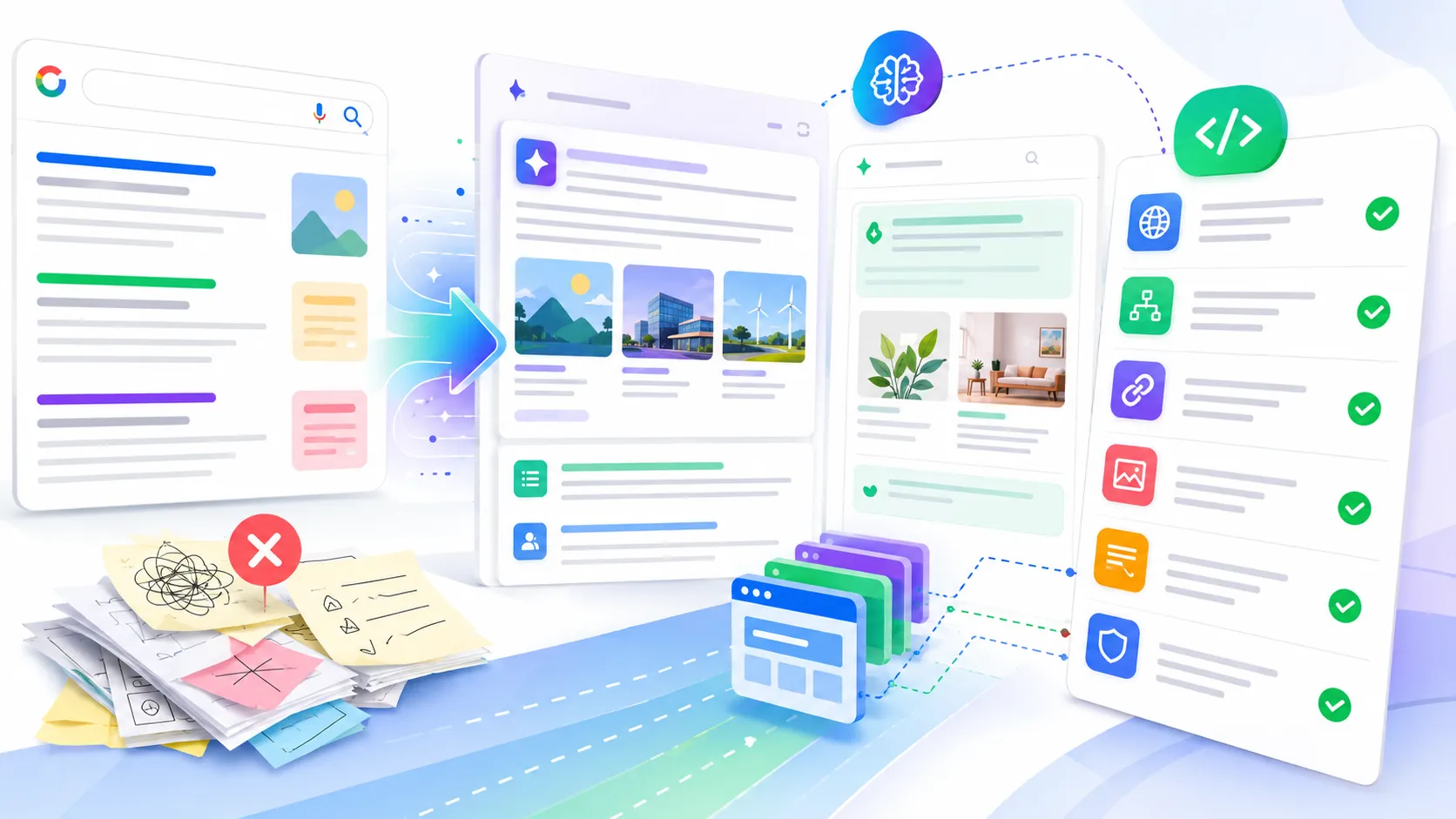
Google AI Search Guide Changes The Argument
The official answer is boring on purpose
The new Google guide for generative AI features is not subtle about what matters. It keeps pulling the discussion back to fundamentals: helpful content, clear pages, crawlability, good page experience, textual content, internal links, sensible images, and structured data that matches what users can actually see.
That sounds almost disappointing if you wanted a secret.
But I think that is the point. Google is trying to kill the idea that AI Overviews and AI Mode require a separate bag of tricks. The guide says you do not need special AI text files, special markup, tiny chunked pages, fake mentions, or a brand-new writing style just to appear in generative AI Search. The older AI features and your website page says the same thing from another angle: if a page can be indexed and shown with a snippet in normal Search, there are no additional technical requirements for these AI features.
That is brutal for vendors selling “drop this file into your site and win AI Search.”
It is also pretty healthy for developers. We already have enough weird build artifacts, stale generated metadata, schema drift, and content tooling that nobody maintains. Adding another pretend protocol because someone saw a LinkedIn carousel is not engineering. It is decoration.
AI Mode still changes the product surface
Here is the part where I do not fully buy the “nothing changed” reaction.
The optimization checklist may be boring, but the Search product is not the same old list of blue links. Google’s May 6 Search update talked about AI Mode and AI Overviews showing more direct links, suggested next reads, source previews, personal perspectives, and news subscription links. That means the page still has to be good enough to become a supporting source inside a generated answer, not just a title in a ranking list.
So yes, the fundamentals survive.
But the presentation layer changed.
That is where developers should pay attention. You can do everything “right” by the old checklist and still make a page that is hard for AI Search to reuse well. If the important answer is buried behind a client-only widget, if the page title promises one thing and the visible content says another, if your images have useless alt text, if the useful comparison table is rendered as a canvas, do not act surprised when the system picks cleaner sources.
The GEO Hacks Google Just Punched
The shortcut list is shorter now
The funny thing about the guide is how directly it names the stuff people have been pitching. It does not say “never experiment.” It says these things are not required for Google Search generative features.
| Tactic | My read after Google’s guide |
|---|---|
llms.txt as a magic ranking file |
Maybe useful elsewhere, not a Google AI Search requirement |
| Chunking every article into tiny blocks | Usually cargo-cult editing unless it helps users |
| Rewriting pages in AI bait language | A good way to make humans leave faster |
| Buying fake mentions | Spam with better branding |
| Special schema for AI Overviews | Not a thing Google is asking for |
This is the kind of clarification I like because it gives teams permission to delete work from the roadmap.
If your backlog has a task called “add AI visibility markup,” pause it. Ask what measurable user or crawler problem it solves. If the answer is just “AI needs it,” the task probably belongs in the bin.
I had a similar argument in the older AAO post, but Google’s new guide changes the tone. Back then, the scary framing was that agents would choose for users and sites needed to prepare. I still think agentic browsing matters. Google even points people toward agent-friendly website practices. But this update makes one boundary clearer: for Google Search itself, do not confuse agent readiness with fake SEO rituals.
The one boring hack still works
The best “AI SEO” move is still making pages that machines and humans can both read without drama.
I know. Not exciting.
But try opening your own page with JavaScript disabled. Try fetching it with curl. Try looking at the rendered text in Search Console URL Inspection. Try reading the page title and first screen without your design system loaded. If the core value disappears, you do not have an AI Search problem. You have a web publishing problem.
Try running this against an important URL:
curl -L https://example.com/page \
  | sed -e 's/<script[^>]*>.*<\/script>//g' \
  | grep -iE "title|h1|h2|main|article" \
  | head -40
It is crude. That is why I like it. If the command sees nothing useful, a crawler may still render more than that, but you have already found the smell.
What Developers Should Actually Change
Make crawlability a release check
I would treat AI Search as another reason to make crawlability part of CI. Not an SEO afterthought. A release check.
For a blog or docs site, that can be simple:
- Page returns
200. - Canonical URL is correct.
- Title and description are present.
- Main content exists in HTML.
- Internal links work.
- Images have specific alt text.
- Structured data, if present, matches the visible page.
- Important content is not hidden behind login, consent, or client-only state.
That list is boring enough to automate and important enough to break a release.
The nice part is that it helps normal users too. Faster pages, clearer headings, better internal links, and readable HTML are not “for AI.” They are for the web. The AI layer just punishes sloppy publishing faster because it has more options.
Stop outsourcing judgment to Search Console alone
Google says AI feature impressions and clicks are folded into the normal Web performance report. That is practical, but it also means site owners do not get a clean “AI Mode sent this exact visit” dashboard.
So teams need to be less lazy with measurement.
Watch Search Console, sure. But also watch branded queries, direct traffic, assisted conversions, time on page, scroll depth, and internal search. If AI Overviews answer more simple questions directly, the clicks that survive may be fewer but more serious. Google has been saying clicks from AI experiences can be higher quality. Maybe. I would still verify that in my own analytics before using it in a slide deck.
The recent arXiv study on AI Overviews makes this messier. It found that AI Overviews activate heavily for question-style queries and that cited sources are not always the same as classic first-page results. It also found unsupported claims in a meaningful slice of responses. That is exactly why I would not build a strategy around one vendor’s happy-path blog post.
Use the official guidance. Then measure like you do not fully trust anyone.
The Part Nobody Wants To Say Out Loud
Content farms are going to copy the checklist too
Google saying “make useful, people-first content” is correct. It is also not a moat by itself.
Every content farm can now update its pitch deck to say it follows the official Google AI Search Guide. Every SEO vendor can say “we do fundamentals.” Every CMS plugin can add another toggle and call it generative readiness.
So the real edge is not reading the guide. The edge is doing the parts that are annoying:
- Publishing original experience instead of recycled summaries.
- Keeping pages technically clean after five redesigns.
- Maintaining internal links when URLs change.
- Removing thin pages that only exist for keyword coverage.
- Making product data accurate instead of just structured.
- Writing comparison pages that admit tradeoffs.
That is the stuff AI slop cannot fake forever. Or at least, it cannot fake it cheaply forever.
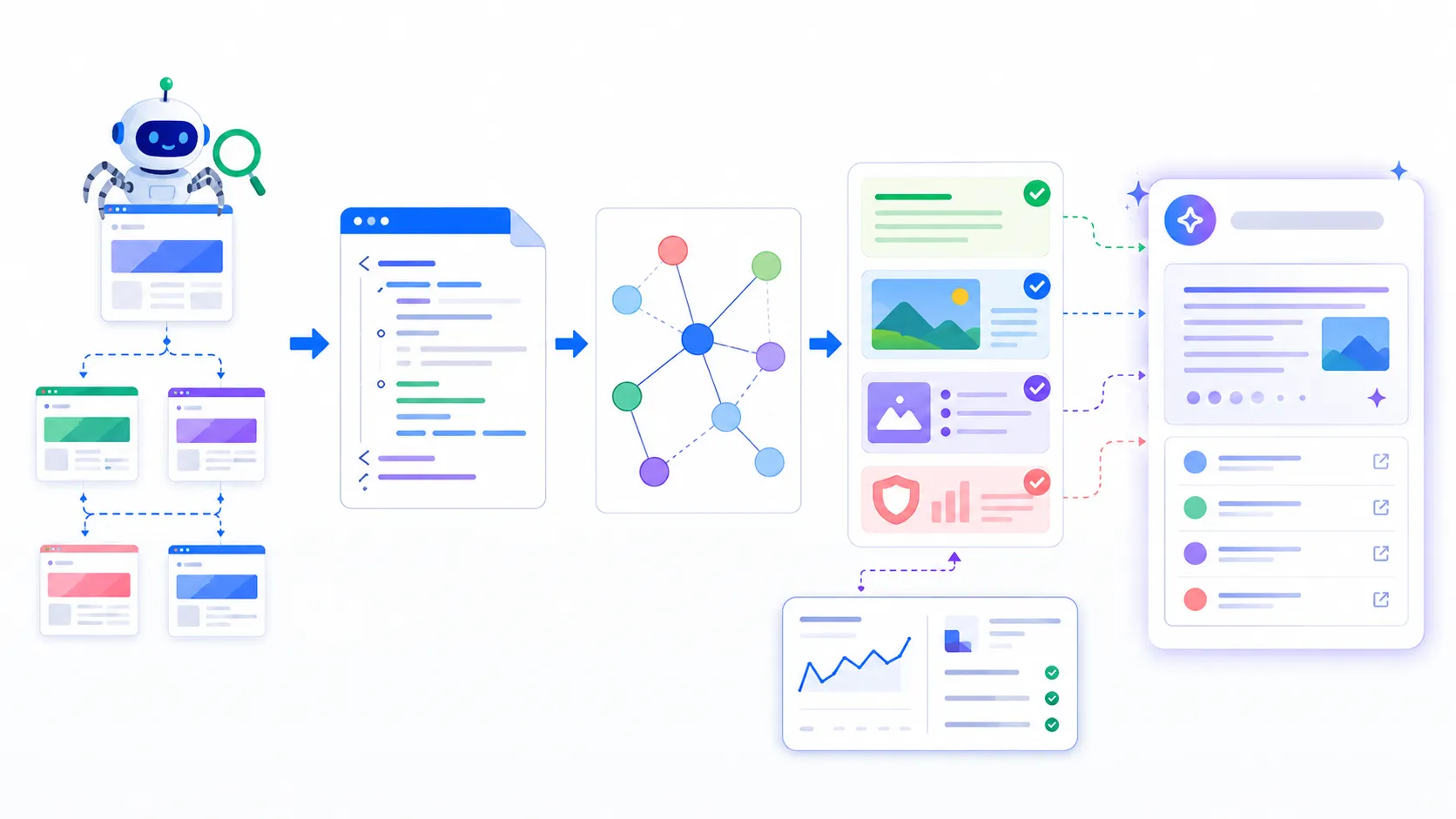
Agent-friendly does not mean agent-obsessed
The most interesting paragraph in the guide is the one about agentic experiences. Google mentions browser agents, DOM inspection, accessibility trees, screenshots, and emerging protocols like Universal Commerce Protocol.
That is the future-facing bit.
But I would not sprint straight into protocol theater. If a browser agent lands on your site today, it mostly needs the same things an impatient human needs: visible content, obvious actions, stable UI, accessible labels, sane forms, predictable URLs, and pages that do not collapse when automation touches them.
So the practical move is not “make a website for bots.”
The move is “make a website that does not require a private ritual to understand.”
That means your docs should have real headings. Your pricing should not be an image. Your product details should not live only inside a hover state. Your checkout should expose readable labels. Your blog posts should have descriptions, internal links, and images that explain something. Your JavaScript should enhance the page, not be the only reason the page exists.
Google’s guide did not kill SEO. It killed some of the fantasy around AI SEO. That is a good trade.
I still expect AI Mode to reshape traffic. I still expect publishers to complain, sometimes fairly. I still expect weird optimization tactics to work for a while in weird corners. But for normal developers shipping normal websites, the assignment got clearer this week.
Build pages that can be crawled. Say something worth citing. Keep the structure clean. Measure the fallout.
Not glamorous. Probably correct.