



Karpathy Anthropic is the kind of phrase that makes half of AI Twitter instantly reach for sports metaphors.
And honestly, I get it. Andrej Karpathy joining Anthropic is not just another famous researcher changing badges. It is one of those weird little personnel moves that says a lot about where frontier AI labs think the next fight is happening.
Not in chat UX. Not in another leaderboard screenshot. Not even in the public model launch circus.
The interesting part is pretraining.

That sounds boring if you only follow AI through product demos. But if you build with these systems every day, pretraining is where the expensive magic still starts. It is also where small process improvements can turn into huge capability jumps later.
So when Reuters reported that Karpathy joined Anthropic’s pretraining team, and Axios added that he will help launch a team using Claude itself to accelerate pretraining research, my first reaction was not “wow, celebrity hire.”
It was: okay, Anthropic is trying to make Claude part of the lab loop that builds the next Claude.
The Hire Is Loud Because The Work Is Quiet
Karpathy Is Not Just A Name On A Slide
The news spread fast because Karpathy has an unusual kind of credibility. He was part of early OpenAI, led AI work at Tesla, built public education material that trained a generation of ML-curious developers, and then helped make “vibe coding” a normal phrase people can say without immediately apologizing.
TechCrunch’s report says he is joining Anthropic under Nick Joseph on the pretraining side. That detail matters more than the headline. Pretraining is not a mascot role. It is the place where model teams make decisions about data, training recipes, scaling, synthetic generation, eval pressure, and the whole pile of experiments that eventually become a Claude release.
That is the work nobody wants to liveblog because most of it is expensive, slow, and confidential.
But that is also exactly why this hire feels bigger than a normal talent-war headline.
The Real Story Is Research Automation
Axios framed the move around elite AI talent. Fair. The talent market is brutal. Everyone knows the top labs are fighting over a tiny group of researchers who can operate at frontier scale without pretending benchmark graphs are the whole job.
But the sharper bit is the reported team focus: using Claude to accelerate pretraining research itself.
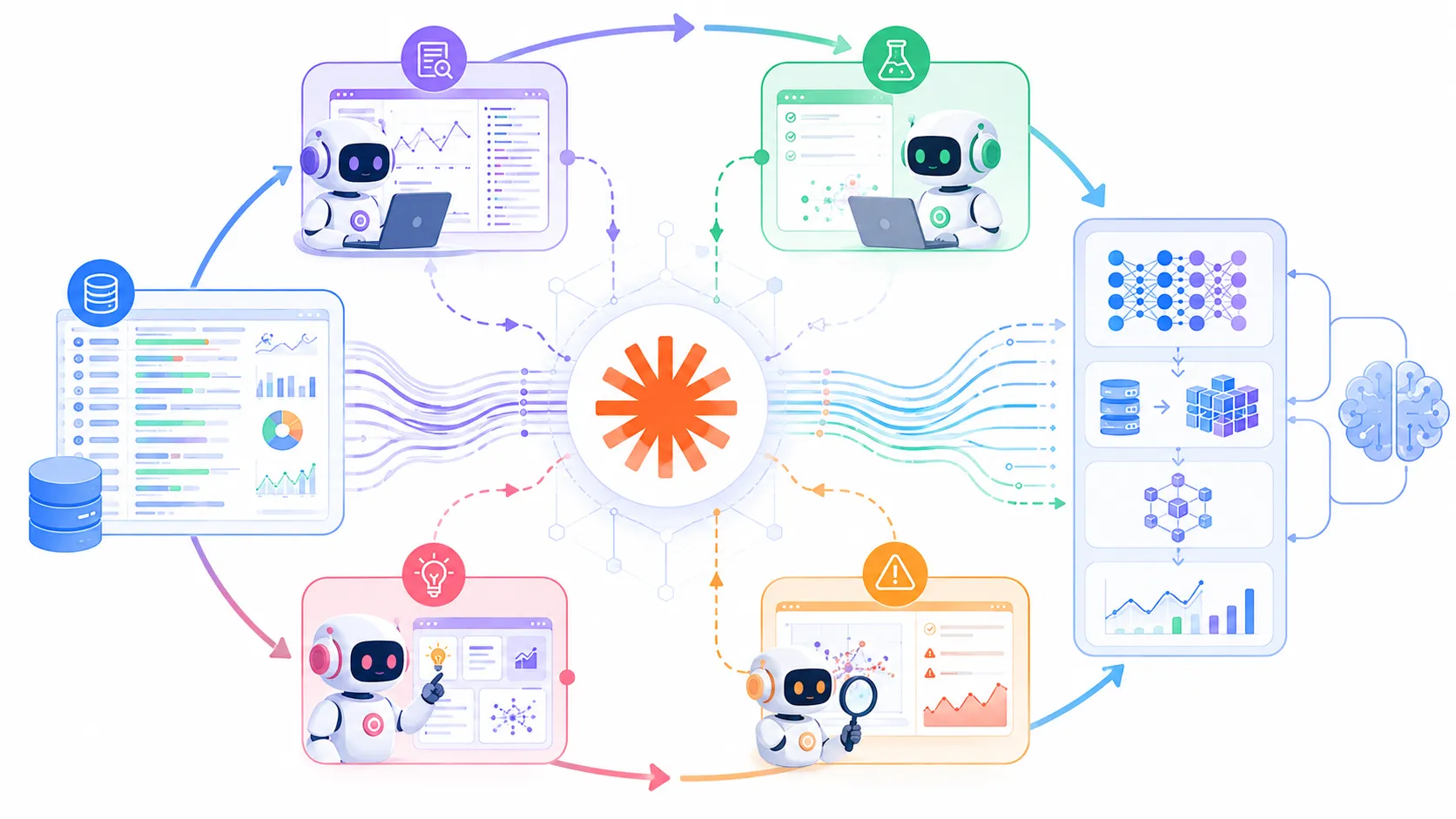
That is a very different claim from “we hired a strong researcher.” It says Anthropic wants AI systems to help improve the research pipeline that makes future AI systems. Not in a sci-fi, self-improving machine way where everyone starts yelling in all caps. More like: thousands of annoying research tasks can be compressed if the lab has the right model, tools, evals, memory, and human review loop.
I keep thinking about how this connects to the agent tooling layer we just saw in Google Antigravity 2 Puts AI Coding Agents On Your Desktop. Google is making agents visible as developer surfaces. Anthropic, with this move, looks more interested in agents as internal research leverage.
Both are about the same pressure.
The bottleneck is moving from “can the model answer” to “can the model reliably do useful work inside a controlled loop.”
Why Developers Should Care
Claude Gets Judged In Repos Now
If you are a normal software developer, pretraining might feel like someone else’s problem. You just want Claude Code to stop overediting files, keep the plan stable, explain its test failures, and not burn through a context window like it found free coffee.
Same.
But the model behavior we complain about in repos starts much earlier than the product wrapper. Tool use, long-horizon coherence, code reasoning, style imitation, security caution, and recovery after a bad assumption are all downstream of training decisions.
That is why I care who works on the training loop.
The frontend of AI coding is becoming crowded: Cursor, Codex, Claude Code, Antigravity, Windsurf, Zed agents, OpenCode, and a pile of smaller tools. The durable advantage may not be the editor panel. It may be the lab that can keep making the underlying worker model more reliable at research and engineering tasks without exploding cost.
And yes, that is less flashy than a keynote demo. It is also probably more important.
The Talent War Is Really A Workflow War
People love treating AI lab hiring like sports free agency. I understand the instinct. It gives everyone a simple story: this person joined that team, so that team is winning.
But labs do not win because one famous person walks through the door. They win when that person changes the workflow around them.
For Karpathy, the workflow angle is obvious. He has spent years making difficult AI concepts legible to developers. He has also been unusually public about coding with frontier models, pushing tools hard enough to find the weird edges. That combination is rare: research taste, production exposure, and a teacher’s instinct for where humans lose the plot.
If Anthropic can plug that into pretraining research automation, the upside is not just a better model card. It is a faster experimental loop.
Try to imagine the boring version:
python run_eval.py --suite code-repair --model claude-next
python summarize_failures.py --cluster-by root-cause
python propose_experiments.py --budget 2000-gpu-hours
python review_training_run.py --compare baseline previous-best
Obviously the real system is not four cute shell commands. But the shape is right. Agent-assisted research only matters if it can generate useful hypotheses, inspect failures, connect them to training changes, and survive expert review.
That is the world this hire points toward.
The Part I Am Skeptical About
Recursive Hype Gets Sloppy Fast
The phrase “using Claude to improve Claude” is going to attract bad takes immediately.
Some people will call it recursive self-improvement and act like the singularity is scheduled for Thursday. Others will roll their eyes and say it is just another internal productivity tool. Both reactions are too clean.
The practical middle is more interesting. Claude can probably help researchers search experiment logs, draft eval analysis, propose ablations, write harness code, compare papers, generate synthetic tasks, and find patterns in failure clusters. That is not magic. It is useful leverage.
But it is also easy to fool yourself.
If a model helps design the test, interpret the result, and propose the next training run, the lab needs very serious guardrails around measurement. Otherwise you get the AI research version of overfitting a benchmark while calling it strategy.
That is the part I want Anthropic to be extremely boring about.
Education Work May Get Paused
There is also a smaller human detail here that developers will feel. VentureBeat noted the question around Eureka Labs and Karpathy’s education work. Karpathy said he remains passionate about education and plans to resume it in time, but joining a frontier lab’s pretraining effort is not exactly a light side quest.
I would be lying if I said I am not a little disappointed by that.
Karpathy’s best public work has always had this strange property: it makes hard things feel buildable. His lectures and walkthroughs did not just explain neural networks. They gave developers permission to touch the machinery.
Frontier labs need people like that internally. The public internet also needs them externally.
Both things can be true.
This Changes The Claude Story
Anthropic Is Buying Time With Taste
The Reuters piece put the move inside the broader competition with OpenAI and other frontier model developers. That is the obvious industry frame. Compute is expensive. Talent is scarce. Distribution is messy. Everyone is trying to get more capability per dollar and more trust per release.
What makes Anthropic interesting right now is that it is not only competing on model launches. It is competing on taste.
Claude Code has taste. MCP had taste. The company talks about safety in a way that can be annoying, sure, but it is at least an actual product philosophy instead of a checkbox buried behind the keynote. Hiring Karpathy into pretraining fits that pattern. It says the research system itself needs taste, not just more GPUs.
That is not automatically enough. Google has distribution. OpenAI has product velocity. Meta has open-weight pressure. xAI has compute theater and a willingness to move fast in weird directions.
Anthropic has to turn taste into compounding execution.
Karpathy joining helps that story, but it does not prove it.
I Want To See The Boring Evidence
Here is what would make me believe this matters over the next few months.
I want Claude to get noticeably better at keeping long software tasks coherent. I want fewer confident rewrites. I want better test failure diagnosis. I want code agents that can say “this plan is wrong” before they mutate six files. I want research claims that include failure analysis instead of only victory charts.
I also want Anthropic to keep showing restraint around agent autonomy. More capable models inside stronger loops are useful. They are also exactly where teams start treating fluent output as permission to skip review.
So no, I do not think one hire means Anthropic suddenly wins the AI race.
But I do think this is the most interesting kind of hire: one that hints at a workflow change, not just a brand upgrade.
If Claude starts improving faster in the boring places developers actually feel, this week will look less like gossip and more like an early signal.
For now, I am watching the pretraining loop.
Not the press release.