



Uber AI coding costs are suddenly the cleanest story in developer tools because the numbers are messy in exactly the way real engineering organizations are messy.
The headline version is spicy: Uber pushed Claude Code and Cursor across engineering, usage exploded, and the company had to rethink the 2026 AI budget only a few months into the year. GeekNews surfaced the Briefs summary on May 2, and the story landed because every team using coding agents has felt some smaller version of the same thing. The tool works. People use it more. Finance opens the dashboard. Everyone starts pretending they always cared about token hygiene.

The more interesting part is that this is not just “AI is expensive.” That take is too lazy. A useless tool does not blow a budget through adoption. It dies in onboarding. What seems to have happened at Uber is more annoying and more useful: agentic coding became valuable enough that the old budget model stopped matching reality.
Why This Story Hit Developers So Hard
It turns token spend into an engineering management problem
According to The Information’s Applied AI piece, Uber CTO Praveen Neppalli Naga described Claude Code usage growing beyond expectations. Benzinga’s recap says Uber was pushed “back to the drawing board” after Claude Code and Cursor adoption rose fast enough to create budget pressure.
That line is the whole post for me.
Most companies still budget AI coding tools like they are seat licenses. Twenty bucks here. Sixty bucks there. Maybe a few enterprise seats. Nice clean SaaS math. But serious agent workflows do not behave like normal SaaS seats. They behave more like cloud compute. One engineer can casually run the equivalent of a tiny distributed system if the workflow includes multiple agents, long context, repo-wide search, test loops, screenshots, logs, web lookups, and repeated review passes.
That does not make the engineer irresponsible by default. It means the cost model has moved from “who has access” to “what work did the agent actually perform.”
If your finance model still sees Claude Code as a subscription and your engineering team sees it as elastic compute for thought work, you are going to have a weird quarter.
The reported numbers are useful, but not all equally solid
The viral summaries say a few big things: monthly API costs around $500 to $2,000 per engineer, 95 percent monthly AI tool usage, and a claim that 70 percent of committed code came from AI. The GeekNews page also includes a useful Hacker News correction thread: commenters point out that the original source appears to describe about 11 percent of live backend updates being written mainly by AI agents, while the exact company-wide AI coding spend was not publicly disclosed.
That discrepancy matters.
Not because it kills the story. It actually makes the story better. This is exactly what happens when AI productivity reporting moves faster than accounting definitions. Is “AI-generated code” a full patch from an agent? A completion accepted in an IDE? A diff drafted by Claude and rewritten by a human? A backend update shipped by an internal agent? A commit where any meaningful line came from a model?
Those are not the same metric.
And if the metric is fuzzy, the budget conversation gets fuzzy too.
| Question | Bad Metric | Better Metric |
|---|---|---|
| Are engineers using AI? | Active seats | Agent hours by workflow |
| Is AI writing code? | Lines touched | Reviewed shipped changes by risk class |
| Is spend controlled? | Monthly tool invoice | Cost per merged change and per incident avoided |
| Is productivity real? | Percent AI-generated | Lead time, rework rate, escaped defects |
I do not want a dashboard that says “70 percent AI.” I want a dashboard that says “this category of work got 38 percent faster, review load rose 12 percent, incidents did not move, and model spend per merged PR was $18.”
That is the version a CTO can actually defend.
Claude Code Changed The Shape Of The Bill
The expensive part is not the model name
It is tempting to make this a Claude Code story because Claude Code is the tool in the headline. And sure, it matters. Anthropic describes Claude Code as an agentic coding tool that lives in the terminal and helps turn ideas into code. Developers like it because it works inside the actual repo instead of hovering beside it like a polite autocomplete widget.
But the bigger shift is not “Claude is expensive.” The bigger shift is that agentic coding changes the unit of work.
Old coding assistant billing was easy to reason about. You type. It completes. Maybe it chats. The tool mostly waits for you.
Agentic billing is different. The tool reads files, runs tests, follows errors, searches logs, writes patches, opens more files, asks the shell for context, rewrites the patch, and then does the same loop again after tests fail. That is why usage can double before anyone feels like their behavior changed. The workflow itself got deeper.
This is also why I think the next serious platform role is not “AI prompt manager.” It is TokenOps. Not as a cute job title. As a real operating discipline.
TokenOps is the boring layer that decides which model is allowed for which workflow, when long context is justified, how tool output is compressed, when a fresh session is required, which agents can run in parallel, and how expensive modes get approved. It is FinOps, but for code-generation loops that can mutate production software.
I know that sounds painfully unglamorous. Good. The glamorous version is how budgets get cooked by invisible loops.
Cursor plateauing is a product signal
One detail in the reporting stuck with me: Cursor usage reportedly plateaued while Claude Code became the dominant workflow at Uber. I would not overread that, but it tracks with what I see in teams.
Cursor is excellent when the human is still centered in the editor. You are shaping the code directly, reviewing inline suggestions, asking for a local change, and staying in the loop.
Claude Code feels different when the task is messier. It is better suited to “go inspect this repo, make the change, run the checks, and come back with the diff.” That is not always better. Sometimes it is worse. But it pushes spend into a very different pattern because the agent is doing more unattended work per request.
OpenAI is clearly chasing the same center of gravity with Codex, which it positions as a coding agent for completing real development tasks end to end. So even if Uber swaps some usage from Claude Code to Codex, the budget lesson probably does not go away. The expensive behavior is not one vendor. It is delegated software work becoming normal.
The Real Risk Is Not Spending Too Much
The real risk is spending without learning
I am less worried about Uber spending too much on AI coding tools than I am about companies spending a lot and learning almost nothing.
If a team burns through budget and can say exactly what improved, fine. Maybe the spend is justified. Maybe $1,000 per engineer per month is cheap if it removes weeks of waiting from the roadmap. Software engineers are expensive. Slow coordination is expensive. Delayed product learning is expensive.
But if the only output is “everyone used AI more,” that is not a productivity story. That is adoption theater.
This is where the governance discussion has to get more concrete. Axios reported in April that Cursor partnered with Chainguard to reduce the risk of AI tools pulling vulnerable or malicious dependencies into projects. That is the same category of problem as budget control: once agents do more real work, the surrounding controls matter more than the demo.
The academic side is circling the same drain. A recent arXiv paper, Engineering Pitfalls in AI Coding Tools, analyzed thousands of bugs across Claude Code, Codex, and Gemini CLI repositories. Another paper, Dive into Claude Code, frames Claude Code as part of a broader design space for agent systems that can run commands and call tools. That is the world we are in now. These are not autocomplete toys. They are semi-autonomous actors inside engineering systems.
So yeah, measure the invoice. But also measure the blast radius.
A sane policy is more useful than a cheaper model
The first reaction to a budget spike is usually vendor shopping. Try Codex. Try a cheaper Claude tier. Try open weights. Route easy tasks to a smaller model. All good.
But model routing without workflow policy is just moving the leak.
Here is the checklist I would want before giving a large team broad agent access:
- Classify work by risk: docs, tests, internal tools, customer-facing code, infra, data paths.
- Set model and context limits by risk class, not by engineer seniority alone.
- Require explicit approval for destructive commands, production credentials, and data deletion paths.
- Track cost per accepted PR, not just cost per user.
- Track rework and review time, because cheap bad code is expensive code wearing a costume.
- Compress tool output aggressively instead of dumping logs and snapshots into the model every loop.
- Keep humans accountable for architecture, test strategy, and release decisions.
That last one sounds obvious until an org starts rewarding AI usage as a KPI. Then people optimize for visible AI activity instead of good software. The Hacker News comments under the GeekNews thread were blunt about this: if managers turn usage into a performance signal, usage will rise whether or not value rises with it.
That is not an AI problem. That is a management problem with a faster feedback loop.
What I Would Copy From Uber
Roll it out, but instrument it like infrastructure
Honestly, I like that Uber pushed hard enough to hit the wall early. That is better than running a timid pilot forever and pretending the future will wait for procurement.
The mistake would be treating the wall as proof that AI coding tools are bad. The better read is that serious adoption needs serious telemetry. If developers are using these tools because they are genuinely useful, then the company needs cloud-style cost controls, not a moral panic about expensive tokens.
I would copy the aggressive adoption. I would not copy vague metrics.
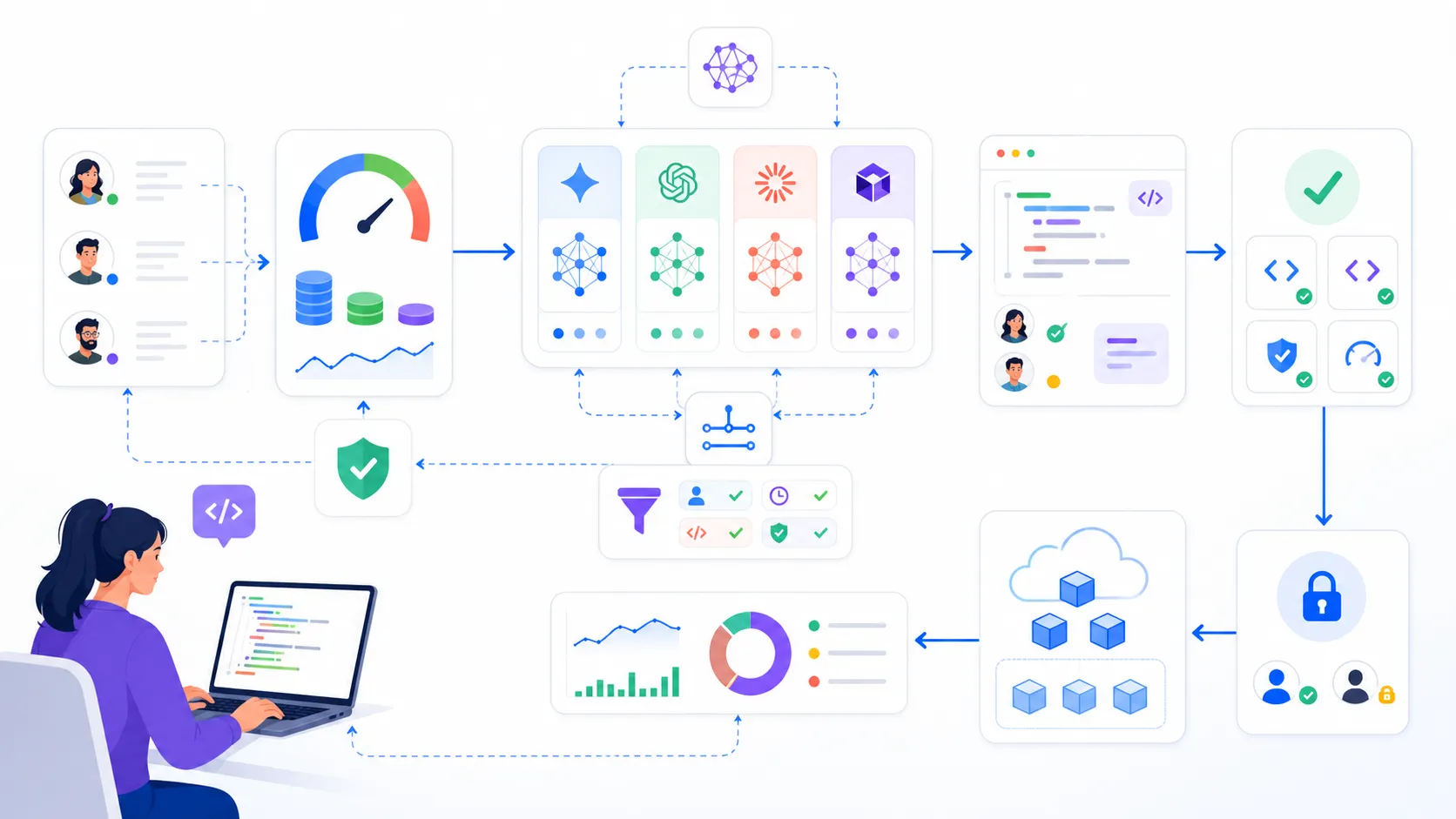
Give teams the tools. Let them run real work. Then instrument:
# try tracking this per merged PR, not per person
agent_cost_usd
agent_wall_time_minutes
human_review_minutes
test_failures_before_merge
reverts_within_14_days
escaped_defects
That kind of dataset will make some people uncomfortable because it turns vague productivity claims into actual tradeoffs. Good. The entire AI coding conversation needs fewer vibes and more receipts.
The budget reset is probably the beginning, not the end
The funny part is that this story sounds like a warning, but it might age as an early adoption marker. When AWS bills exploded in the cloud era, companies did not go back to racking servers for every workload. They invented FinOps, reserved capacity planning, tagging policies, spend alerts, and architectural review for expensive paths.
AI coding tools are walking into the same phase.
I wrote recently about Context Mode and long AI coding sessions, and this Uber story feels like the finance-side version of the same issue. Context is money. Tool calls are money. Parallel agents are money. Bad prompts are money. Unbounded autonomy is money with root access.
So the practical lesson is not “ban Claude Code.” It is also not “let everyone run the biggest model all day because engineers are expensive.”
The lesson is simpler: if AI agents are now part of the engineering production line, manage them like production infrastructure.
Budgets. Policies. Observability. Review gates. Incident learning. Clear ownership.
That is less exciting than a viral headline about burning a budget in four months. It is also the only version that survives contact with a real engineering org.